
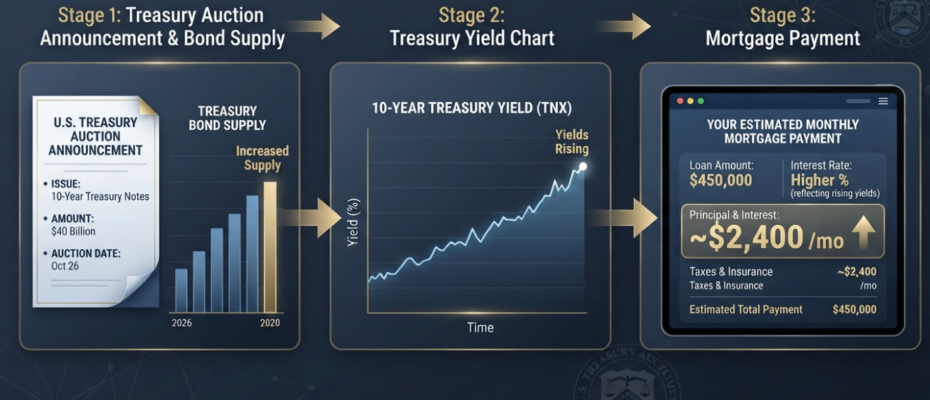
Mortgage rate conversations usually focus on inflation, the Federal Reserve, and the monthly jobs report. Government borrowing belongs in that conversation too.
The U.S. Treasury finances federal borrowing by selling bills, notes, bonds, inflation protected securities, and floating rate notes. Investors must absorb that supply. If demand is not strong enough at the available yield, the market may require a higher yield to clear the auction.
That can affect the broader bond market, including mortgage backed securities. Government borrowing is one of the seven forces in my guide to what moves mortgage rates.
Quick answer: Treasury auctions can influence mortgage rates because Treasury yields are a benchmark for long term borrowing. Strong demand can support bond prices and yields. Weak demand can push yields higher and pressure mortgage backed securities. Auction supply is one factor among many, not an automatic rate formula.
Why the Treasury Sells Debt
When federal spending exceeds revenue, Treasury must borrow to finance the difference and refinance maturing debt. It does that by issuing marketable securities across different maturities.
The amount, maturity mix, and timing of issuance matter because investors have finite balance sheets. Banks, funds, pensions, insurers, foreign institutions, households, and dealers all decide how much Treasury risk they want at a given yield.
How a Treasury Auction Works
Treasury announces the security, offering amount, auction date, issue date, maturity, and bidding terms. It accepts valid noncompetitive bids first, then competitive bids from the lowest yield upward until the offering is awarded. Successful bidders receive the same final accepted yield or rate for that auction.
The auction result gives the market a real time test of demand. A smooth auction can calm supply concerns. A weak auction can push yields higher across the curve.
What Traders Mean by a Strong or Weak Auction
Professional traders look beyond whether Treasury sold the full amount. The auction process is designed to sell the securities. The question is how much yield the market required and who absorbed the supply.
Common measures include:
- The high yield compared with the yield in preauction trading
- The bid to cover ratio, which compares bids received with the amount offered
- The share awarded to indirect bidders, direct bidders, and primary dealers
A result that needs a higher yield than the market expected is often described as a tail. A result that clears at a lower yield than expected is often described as stopping through. These are market conventions, not grades printed by Treasury.
Why More Bond Supply Can Raise Yields
Think of yield as the price needed to attract enough buyers. If the market must absorb more debt and investor demand does not rise with it, yields may need to increase.
That does not mean every increase in issuance causes mortgage rates to rise. Strong demand, lower inflation, slower growth, or global demand for safe assets can absorb additional supply. The effect depends on the entire market backdrop.
How an Auction Reaches Mortgage Rates
The connection generally runs through the broader bond market:
1. Treasury announces or sells a large amount of debt
2. Investors demand a higher or lower yield based on supply and demand
3. Treasury yields move across the market
4. Mortgage backed securities adjust relative to those benchmarks
5. Lenders may change rates, points, or credits
The movement can happen before the auction if traders anticipate the result. Markets price expectations first and the actual result second.
Check today’s St. Louis mortgage rates to see how the current bond market is reaching lender pricing.
What Treasury Buybacks Do and Do Not Do
Treasury buybacks can support market liquidity and help manage the government’s cash and maturity profile by repurchasing selected outstanding securities.
A buyback does not automatically erase the government’s overall borrowing need. Treasury can buy back older securities while issuing other debt. The market therefore distinguishes between a liquidity operation and a lasting reduction in net borrowing.
Why Deficits Matter Without Making a Political Claim
Mortgage rate analysis does not require a partisan argument. The market question is mechanical: how much debt must be financed, what maturities will be issued, and what yield investors require to hold it.
Tax policy, spending, economic growth, and interest costs all influence borrowing needs. Bond investors price the resulting supply along with inflation and economic risk.
What This Means for a St Louis Buyer
A Treasury auction in Washington can change financing costs for a buyer in St. Louis, but it does not determine whether the buyer should purchase a specific house.
A higher rate may reduce buying power, while greater local inventory or a motivated seller may create room for a credit that lowers the payment. In some St. Louis price ranges, the negotiation can matter more than a small change in the national rate.
Compare a seller concession with a price cut using the Seller Credit vs Price Reduction Calculator. If a temporary payment reduction is being considered, use the Temporary Buydown Calculator before writing the offer.
What Buyers Should Watch
Most buyers do not need to follow every Treasury auction. The 10 year and 30 year auctions tend to receive more attention when long term yields are already volatile or the market is worried about supply.
If you are floating a rate around a major auction, know that the reaction can be immediate and can reverse quickly. Decide in advance how much payment risk you are willing to accept.
The Bottom Line
Treasury auctions are a live test of the price investors demand to finance government borrowing. Strong demand can support the bond market. Weak demand can push yields higher and pressure mortgage pricing.
For the full rate framework, read What Really Moves Mortgage Rates. Then use today’s St. Louis mortgage rates to connect the national bond market with current local pricing.
Frequently Asked Questions
Does a Weak Treasury Auction Always Raise Mortgage Rates
No. It can pressure yields, but inflation data, economic news, global risk, and MBS performance may offset or reverse the move.
What Is the Bid to Cover Ratio
It compares the total amount bid with the amount of securities offered. It is one measure of demand, but traders also compare it with recent auctions and study the final yield and bidder mix.
What Does It Mean When an Auction Tails
It means the auction cleared at a higher yield than the market expected immediately beforehand. That can signal weaker demand, although the size of the difference and the broader market reaction matter.
Do Treasury Buybacks Lower Mortgage Rates
Not automatically. Buybacks can improve liquidity in selected securities, but mortgage rates still reflect inflation, growth, net Treasury supply, MBS demand, and lender pricing.
Want to Learn More?
What Really Moves Mortgage Rates? The 7 Forces I Watch Every Morning