The conversation around mortgage rates has changed dramatically over the past several months.
For years, most people assumed mortgage rates moved based on one thing:
What the Federal Reserve was doing.
That is no longer the full story.
Today, global instability, long term inflation fears, government debt, and investor confidence are playing a massive role in where rates go next. And right now, the bond market is sending a very clear message.
The 30 Year Treasury Is Flashing Warning Signs
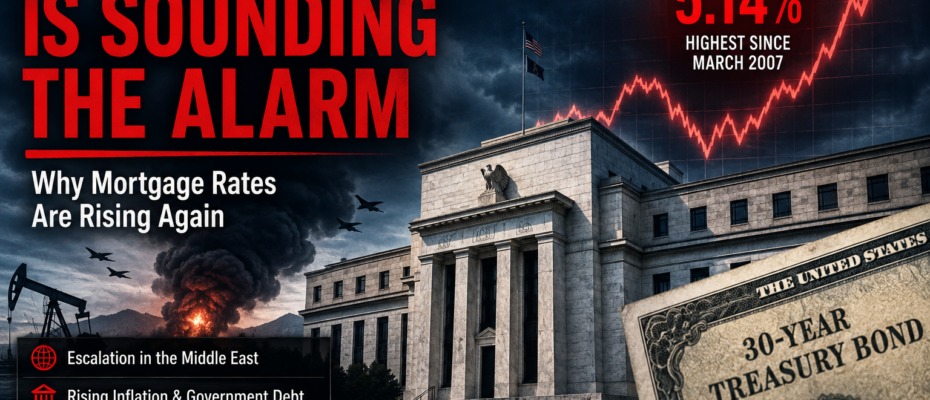
The 30 year Treasury is currently sitting at levels we have not seen since March of 2007.
That matters much more than most people realize.
Yes, shorter term Treasury yields like the 2 year, 5 year, and even the 10 year have traded at elevated levels before. Those spikes typically signal concern about short term inflation or aggressive Federal Reserve policy.
But the 30 year Treasury tells a different story.
When long term Treasury yields climb this high, the market is signaling concern about long term stability, inflation, and confidence in the future direction of the economy.
That is a very different problem.
Why Long Term Rates Matter for Mortgage Rates
Mortgage rates are heavily influenced by the bond market, especially Mortgage Backed Securities and long term Treasury yields.
When investors become worried about inflation remaining elevated for years instead of months, they demand higher returns for lending money long term. That pushes bond yields higher and mortgage rates higher along with them.
And right now, the market is increasingly worried that inflation may remain sticky because of:
- Ongoing geopolitical conflict
- Rising oil and energy prices
- Continued government spending
- Ballooning national debt
- Long term economic uncertainty
The War in Iran Is Still Moving Markets
One of the largest drivers of market volatility right now continues to be the conflict involving Iran.
What was initially presented as a short term conflict has now stretched well beyond expectations, with no clear resolution in sight.
Markets can handle uncertainty temporarily.
What they struggle with is prolonged instability with no clear plan forward.
Every new headline involving:
- Peace negotiations
- Oil supply concerns
- Military escalation
- Shipping disruptions
- Sanctions
- Ceasefire talks
…continues to move the bond market in real time.
And when markets get nervous, mortgage rates typically rise.
Why Mortgage Rates Are NOT at 19 Year Highs
Here is the interesting part.
Mortgage rates themselves are not at 19 year highs.
In fact, mortgage rates were actually worse at points last year than they are right now.
Why?
Because the market is currently pricing more risk into US Treasuries than Mortgage Backed Securities.
That is highly unusual.
Normally, Treasury bonds are considered the safest investment in the world. But growing concerns over government debt, prolonged conflict, inflation pressure, and long term fiscal stability are causing investors to demand much higher yields on government debt.
Meanwhile, Mortgage Backed Securities have held up better than expected.
That has narrowed the spread between Treasury yields and mortgage rates.
Markets React to Confidence, Not Just Data
Economic reports still matter.
But confidence matters more.
Markets react to tone, leadership, stability, and predictability. Investors want confidence that there is a clear plan forward.
Right now, uncertainty continues to dominate the conversation.
That uncertainty is one of the biggest reasons mortgage rates remain elevated.
What This Means for Homebuyers and Homeowners
If you are waiting for mortgage rates to suddenly crash lower, the current bond market is signaling that may not happen quickly.
That does not mean buying a home is a bad decision.
It means strategy matters more than ever.
The right loan structure, timing, and guidance can make a huge difference in affordability and long term financial success.
At Better Rate Mortgage, we help clients understand the market instead of just reacting to headlines.
Because I, Sean Zalmanoff, own the company and sets the margins directly, Better Rate Mortgage is able to offer aggressive pricing without layers of management and unnecessary overhead driving costs higher.
Frequently Asked Questions About Mortgage Rates and the Bond Market
Why are mortgage rates rising if the Fed is talking about rate cuts?
Mortgage rates are primarily driven by the bond market, inflation expectations, and long term Treasury yields, not directly by the Fed Funds Rate.
Does war impact mortgage rates?
Yes. Wars and geopolitical instability can increase oil prices, inflation fears, and investor uncertainty, all of which can push mortgage rates higher.
What is the relationship between Treasury yields and mortgage rates?
Mortgage rates generally follow long term Treasury yields and Mortgage Backed Securities pricing. When yields rise, mortgage rates usually rise as well.
Why are mortgage rates lower than Treasury yields would suggest?
The spread between Mortgage Backed Securities and Treasuries has tightened because investors are currently viewing government debt as carrying more long term risk than normal.
Should I wait to buy until rates come down?
Trying to perfectly time rates is extremely difficult. Many buyers benefit more from having a smart long term strategy and refinancing later if rates improve.
Ready to Explore Your Options?
Whether you are buying your first home, moving up, refinancing, or simply trying to understand the market, we are here to help.
? Contact Better Rate Mortgage today for a personalized mortgage strategy and competitive rates designed around your goals.
Sean Zalmanoff May 19, 2026